History is made at night
Character is what you are in the dark
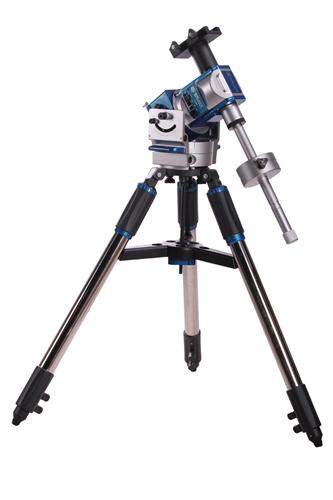
Interesting new product Monday: The new Meade LX80
As I mentioned once before, amateur astronomers love their stuff. There are many of them out there that happily keep a dozen or more telescopes, long with a dizzying array of do-dads and accessories that go along with them.
I take a different approach, but I still love to keep track of what’s new and cool. So, I thought Monday would be a good day to post about some of what’s coming and what’s out there.
Available in any color you like, as long as it
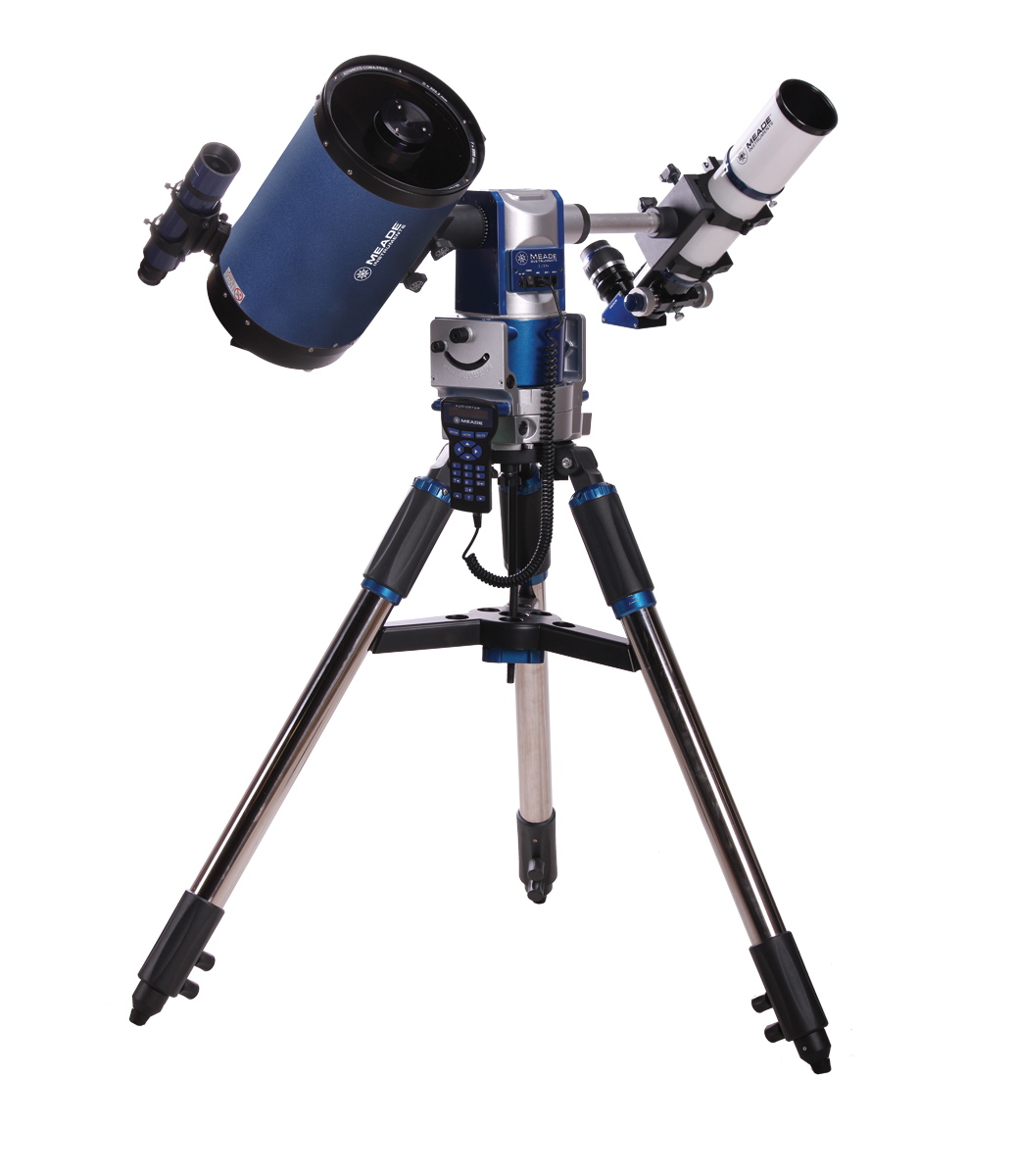
Meade is about to start shipping a the new LX80 mount next month and I think it’s worth a close look. It is advertised as “Three mounts in one”, but it’s more like two with some swappable bits.
Nah, I
You can set it up as an equatorial mount OR an altazimuth mount, then choose between using a counterweight or slapping a second scope while in the alt-az mode. By looking at its design, it resembles a tiny version of one of their top-end robotic mounts and claims it can hold 70lbs(!) of payload, though that’s the two-up configuration only, otherwise it’s 40lbs, which is still impressive for a $800 unit. The way it’s described, this price includes the tripod and it has some crazy feature that talks to you about the things you’re viewing. Seems like a built-in Skyscout and kind of gimmicky. It’s cheap for a medium capacity goto mount and Meade is a good name, but is the person who drops $800 on only a mount really going to want to have it tell them facts about the moon? Maybe, but I don’t think so. And no polar finderscope?
Regardless, I think unless this thing turns out to be a piece of junk, which is doubtful, this will be a HUGELY popular item.
Of course, as with all things, if you want to step it up, you can add a zero and get the LX800.
Sun, I am disappoint.
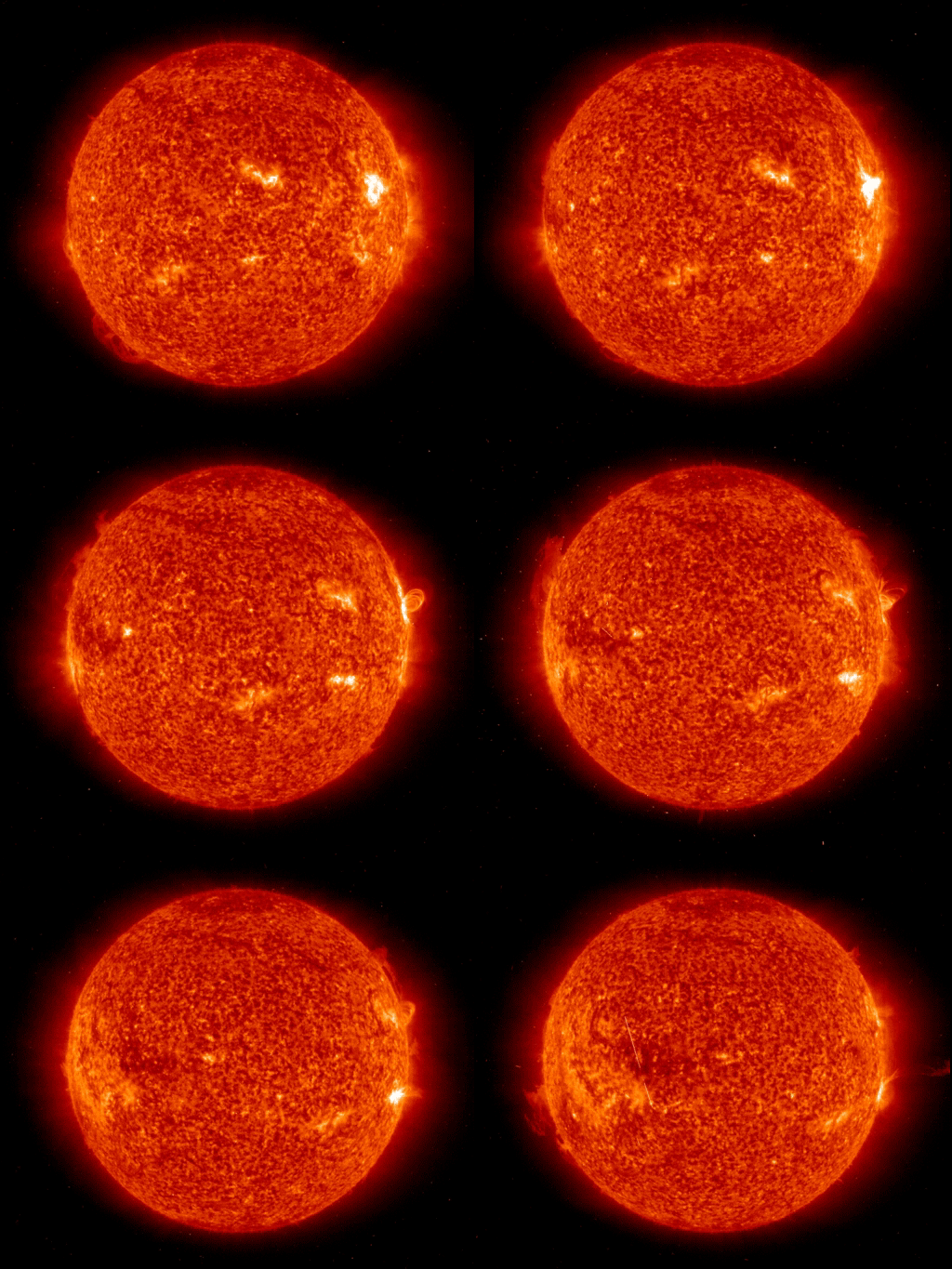
Last Sunday, I suggested that we all take a moment and think about the sun, it’s scale and how it effects (and affects) us. This week, I’ve been thinking about the lack of sun I’ve seen lately. This is New England, which is cloudy often, wet constantly, and must have the least predictable weather in the country. Still, I love it here and when the sun does shine, I think we cantankerous Northeasterners appreciate it a little more. Even if we’re busy pounding down a 32oz iced coffee in January while bitching about Deval Patrick’s office curtains.
All of our thoughts tend to surround the sun’s visible light and heat. We don’t tend to think about the 20 trillion neutrinos that pass through us every second or the far fewer, but more concerning, muons that can wreak havoc with our bodies. We’ve been hearing about neutrinos in the past week, but in a different context.

Seems harmless enough.
Another funny thing we don’t see, which makes a big difference, is the amount of UV light that lights up the sky. The sky looks blue, but that’s just the way our eyes are tuned. We see blue better than violet, but to a hawk, which can see into the UV spectrum it would be something else: a violet sky. Of course the hawk is more interested in the small mammals whose urine would appear to glow brightly in these wavelengths.
At shorter wavelengths, UV stars to get both very useful and dangerous. We all know how much fun it is to get a sun burn and the dangers of skin cancer, though I’ve seen statistics that 90%+ of these are non-melanoma and most are not very dangerous (do your homework on personal safety and don’t take my word or the 11 o’clock news’, ask your doctor and get scientifically verified facts), but this is an astronomy blog and I’m not going to get too into this.
The thing UV does FOR us though, which is very important, is it’s our body’s tool for manufacturing vitamin D, which is not an optional nutrient. Vitamin D deficiency can lead to a LOT of problems, and it doesn’t take much sun to get what you need, especially if you have light skin. 20 minutes in bright Boston sun can produce as much vitamin D as 200 glasses of milk. Again, I’m not here to give you medical advice, do what is right for you, just learn what you can and avoid hype.

But this is definitely cooler looking than any daily supplement.
On the other end of our narrow visible spectrum is infra red. Frederick William Herschel, the guy who also discovered Uranus (go ahead and laugh, there’s no un-funny way to write that), had the good idea in 1781 to put thermometers in each color of the rainbow of light that was refracted by a prism, but also one more, just outside of the red end where nothing seemed to be. His intuition payed off and it became clear that heat was just light outside of the visible spectrum on the red side. The value of this IR light should be pretty obvious. When you use IR night-vision, that’s closer to the visible end of things and colors change dramatically, your black shirt might look white. Go a little further and with the right equipment, you can “see” heat as if it were any other kind of light, but with false colors making it look really trippy.
If there’s a running theme with sun posts, it’s that there’s always WAY more happening than meets the eye (get it?) and when it comes to some of these invisible happenings we literally can’t live without them. Our biology, physiology, psychology and genealogy (as in, ALL the way back) are tied intimately to both the things we see the sun doing and those we don’t. So, the sun does a bit more than just keep us warm and give us enough light to allow for our beloved Ultimate Frisbee championships.
The best and only reason to wear a toupee
Some of you may have noticed that “Starhuckster” sounds oddly familiar. Others may have immediately recognized the reference, while a few probably just think I’m a dork. Actually, you all must think I’m dork, but that’s fine, it’s totally true.
The reason I chose that name, aside from the fact I think it’s pretty funny, was to pay homage to a man who always reminded me to “Keep looking up”. His name was Jack Horkheimer and he was originally known as The Star Huslter. He was, without a doubt, TV’s greatest advocate of naked-eye astronomy. Most of what I saw of him was a late night, pre-signoff, segment that aired on a few broadcast stations, telling me what I’d see if I put down Super Mario Bros. long enough to look at the night sky. Pretty much everyone has seen at least one of these short segments and some may have wondered, as I did, why he chose to wear that toupee. Was he really so vain? Actually, as I recently learned, had he not worn it, his shiny dome would have vanished into the green screen behind him as he flew and flipped through space.
Of course, due to people’s delicate sensibilities and the internet providing expectedly seedy search results when you enter the word “Hustler”, he changed his TV title to Star Gazer in 1997.
Sadly, Jack passed away in 2010, but there’s a new Star Gazer and they’re keeping it real.
UFOs: Utilizing space for fun and profit!
The second installment of “Unqualified Friday Opinions”!

I'd tap that.
While we may all be made of “star stuff”, as Dr. Sagan once said, so is all the other STUFF we like. Holy Toledo, do we like our stuff! We don’t usually think about the cosmic origins of ourselves, our iPods or our Lord of The Rings sword replicas, but all of it has to come from somewhere. The rub, is that digging it up on earth, despite the fact that there’s still plenty left to dig up, is expensive, destructive and no matter how you slice it, depletes a valuable resource in one form or another. For every WiFi ready 3D TV, there are rare earth minerals that were mined and imported. For all the Priuses that silently sneak around the city, there are toxic holes in the ground from where the nickel was mined for their batteries. Don’t even get me started on helium!
“Well, that’s all fine and good, but you can’t expect anyone in the western world to live without high-definition monitors in our bathrooms. How else would we entertain ourselves while we sit upon the throne? Read a book? THAT KILLS TREES!” some might say. Fair enough, there’s no practical way (I can see) to talk people out of their stuff for the sake of the planet continuing to be inhabitable. *A-hem*
So, fortunately, there might be another way. One that we might have worked out by the end of this century. One that is being planned now. We just let it come to us from elsewhere in the solar system! How easy is that?

It's like this, but with spacecraft instead of a cursor.
The idea of asteroid mining has been an element of science fiction for a long time, but we’re now getting to the point of making it a reality and for the record, I’m all for it. I like the Chinese plan, start small and do some science for a while before we do anything risky. The media will, with as much certainty as Apophis missing us, yammer loudly about the Chinese toying with all our lives, but it will amount to nothing but mindless fear-mongering. Nobody wants to take the risk of sending several million tons of rock and metal hurtling toward us uncontrollably, and nobody will. If we take small steps, let the science come first and don’t get too greedy, we’ll all be fine. We shouldn’t pass up a great opportunity for us and our planet for no good reason. Not to mention that learning how to control the orbits of asteroids might be extremely useful someday, it might even save the earth more completely than any amount of recycling ever could.

Well, I guess you could do it this way too.
Of course, this is all still just in the idea phase and there are mind-numbing engineering, economic and even ethical issues that will need to be addressed before we even think about actually trying to pull this off. Still, sometimes I think it pays to think big. One day, this will happen.
What we see and what we get
My wife has a very passing interest in astronomy. She’s smart, she’s blessed with intellectual curiosity and she finds the things I post about interesting (or so she says, she’s also very polite), but there’s more to it than that. The issue for her primarily seems to be the difference between what you see in long exposure shots of celestial wonders versus the reality of what you see in a telescope. I posted earlier about how amazing it is to see things through the eyes of the Keck and Hubble, but even those are multiple long-exposure shots, filtered, processed and layered on top of each other. The result is very beautiful and can even be representative of what things might look like if we were much closer to these objects, but usually they’re false-color for both aesthetic and scientific reasons. To make matters worse, we have a turbulent atmosphere. When you do find an object in your scope, it often boogies around, in and out of focus. The severity of this disturbance is called “the seeing” (“good seeing” refers to less of this, “bad seeing” is more) and is something amateur astronomers are VERY aware of.
Yesterday I posted the Hubble image of the nebula in Orion, which is a beauty. It’s full of color, fine detail and you can easily imagine future space travelers having their futuristic minds blown when they look out the spaceship window and see that staring back at them. On earth, in the 21st century, however, our view is a little different. Of course, a big scope can see more than a small scope, usually, but this is what the Orion nebula looks like for you or me:

Sorry, hubble will always win this contest.
Still very cool, but it’s not even remotely the same thing. I still get excited to see images like this, though through a “normal” privately owned scope, even a big one, it’s not even going to seem as colorful as this. Seeing nebulae and star clusters from a dark field are still amazing and inspiring, provided you don’t think you’re going to see what Hubble sees, it’s just a matter of setting your expectations properly. Every once in a while I see a big scope for sale on ebay, which someone spent A LOT of money to get and then only owns for a few months. They all say the same two things: the scope was bigger than they thought (it really shouldn’t be a surprise that a 16″ mirror needs an even bigger housing) and they didn’t see what they expected to see.
But wait! There’s still some good news. There’s some stuff that is a LOT closer and looks pretty amazing, even in a small scope. For one, we have a large object only 250,000 miles away and it’s covered with crazy stuff. The moon can be enjoyed with the naked eye, but even in a modest telescope, or simple binoculars, the craters and details JUMP out at you.

Now THIS is something you can see and it's been out there, this whole time, just waiting for you to take a closer look.
But what about the planets? Mercury (almost) never gets so far away from the sun that you can get a good look and Venus is so cloudy its phases (just like the moon) are interesting, but that’s about it. Jupiter and Saturn, on the other hand, are my favorite targets. As you can imagine, you’re not going to see them like Voyager did, but they’re still really something to behold.

Not too shabby for 3/4 of a billion miles away.
So, there you go. Expectations are what determine whether or not you’re going to be amazed or disappointed, but choosing a good target can make a big difference too.
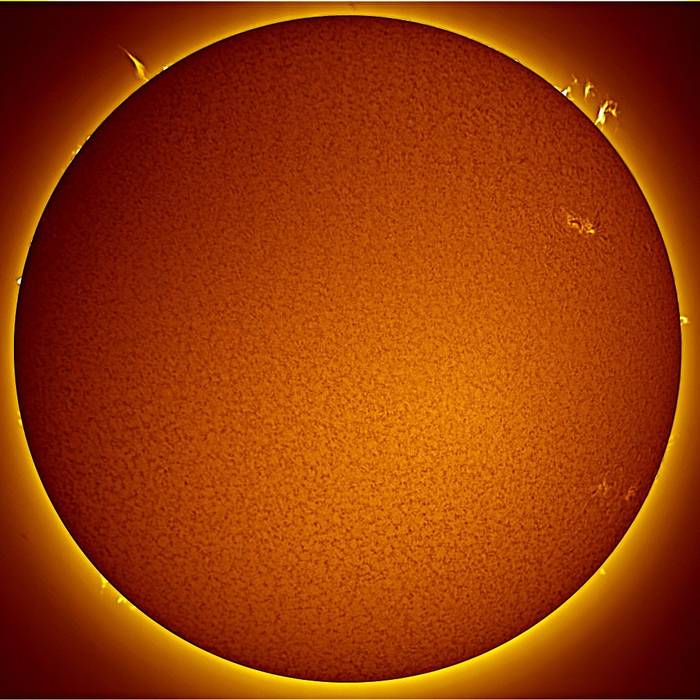
Lastly, don’t forget about the sun. It’s a measly 93 million miles away, friggin huge compared to everything else in the solar system and if you can see it through a good solar telescope, NOT a regular unfiltered scope (you’ll burn your eye out kid), you’ll see more than you might think. Just don’t look at it directly without protective eye-wear, and no, your RayBans don’t count.
Do it right and you can see this. Do it wrong and you'll never see anything again, ever.
The first steps though, should you want to take them, are free. Just find a good spot and look up. Take some time, maybe bring a free star chart or download a free app for your phone. Let yourself have 45 minutes of peace and quiet while looking at the night sky and you’ll come away with something valuable that most people forget they can have. You really can’t go wrong. Plus, you never know, maybe you’ll want to take a closer look next time.
Pictures of the past
Maybe I’m just feeling nostalgic today. It’s my birthday and my mind is on the things that have happened throughout my life. Naturally, I like to let astronomy put these things in perspective.
Light from Eta Boötis that I’ll see tonight (ha ha, like Boston weather would let THAT happen!) left when I was born and took the current span of my life to get here.
If you lived on the planet HD189733b, and you have to REALLY be somebody to live on a planet with such a sexy name, the light our sun gave off when my parents were born is just getting there now.
OK, that’s all fine and good, but let’s step it up, I have birthday stuff to do!

This is what the Orion Nebula was doing while the Roman Empire was chugging along.
Pretty amazing, but this is all still practically next door, astronomically speaking. Let’s keep going.

Remember this one? This is what it looked like when we invented agriculture.
Now we’re talking. I feel like we need to see what was going on out there before people were what we currently consider people though.

Ah, the galactic center. Any photons that make it to us (through all the gas and dust) left home during the stone age.
Those are nice images of stuff in our galaxy, but I want one more for today. Let’s keep it in the family though. Our galaxy is part of a cluster (very creatively called “the local group”), which is part of a group of galaxy clusters that form the Virgo Supercluster.

Sup homies! The light that created this image had been on its way here since about the time an asteroid anihilated the dinosaurs. This is what they looked like while that was happening here.
I love that this last pic was taken with an 8″ telescope too. Click it to see the page of the photographers that took it. They do a lot of great work!
We may not have the capacity to comprehend some of these times and distances, but it’s great to live in a time when such spectacular views are accessible from the comfort of our homes, pants optional. Maybe rather than spending too much time ruminating over the last few decades, I’ll shift my focus to the future today.
Ever dance with the devil in the reflected sunlight?
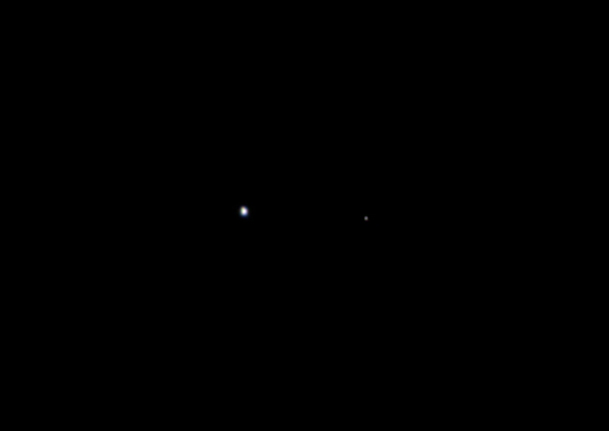
This doesn't look like much, but there may be more to this image than meets the eye.
Being out under an 80% moon the other night had me thinking about all of our funny assumptions that stem from our altered perceptions of things like the moon and its light. Many people have asked themselves things like “Why does the moon look bigger on the horizon?” (which is a subject for another post) or “If the moon looks white in the sky, why does everything seem blue-ish in its light?”. Well, first off, I’d suggest you read Bad Astronomy (like the blog, by the same dude) and get a more detailed answers to these questions, plus many more. Seriously, it’s a quick, fun read.
First things first though, we need a little perspective. If the earth were the size of a basketball, with a diameter of about 9.4″ inches, then the moon would be about the size of a tennis ball, diameter about 2.6″. This ratio isn’t exact, but it’s pretty darn close. I think we all understand the moon is much smaller than earth, so the size difference shouldn’t be a surprise, but something that does surprise a lot of people is that if you use that sizing scale, the tennis ball moon would orbit our home basketball at a distance of 24′! Note, that’s FEET not inches. This example has been talked and blogged about many times, and there’s even a video:
So, the moon is more distant than we generally think of it being. We all know (right?) that the light we see from it is simply the light of the sun shining upon it and as it goes through its phases, the part that we see is the part that faces the sun. Isn’t it funny then that the parts of the moon that aren’t getting direct light seem totally black? I mean, doesn’t the earth reflect light on the moon, like it does for us? Heck, we’re even way bigger and have stuff like clouds and water that reflect visible light pretty well. WHAT IS THE DEAL?
Well, first of all, the moon is actually much darker than people think. We imagine a light-grey, almost whitish, landscape covered with fine dust that happens to be perfect for preserving astronaut footprints. In fact, while it is dusty, the moon’s surface is darker than asphalt. When we see a full moon, that seems to glow white, it seems crazy to think that the surface could be so dark. Secondly, the moon doesn’t have any mechanisms for spreading the light around, like an atmosphere or casinos. The daytime sky on the moon is black.
To put it in the terms of an earthly example…
Imagine, for a moment, that you get into a serious disagreement with your spouse, so they knock you out, lock you in the windowless car of a freight train, shut the door and hope by the time you wake up, you’re half way across the country and have to live out your days in some remote shanty town where you’ll never forget to empty the litterbox EVER again. Before the train can leave the trainyard though, you come to, in the dark, and the only light you see is coming through a small hole in the floor, through which you can see a tiny spot of asphalt in the sun. That asphalt, dark as asphalt can be, would look VERY bright.
Also, I just remembered that I need to empty the litterbox.
But why, then, does the light from the moon look blue-ish? The key is our eyes, not the light. As our eyes adjust to the dark, chemical changes occur and the WAY we see begins to differ. First we lose our ability to see reds, then other colors, until about all we can make out is a pale, bluish green. This is the faintest color we can see, so now you know why those signs on the highway are colored that way and why “high-visibility” wear is usually a specific shade of neon green, which is THE most visible color to our eyes. If you take a long exposure photo or video of moonlight, you see just as much color as sunlight, which is, in fact, all it is.
This video is not only very beautiful, but illustrates this point well. Don’t believe that’s the moon and not the sun? The stars give away the truth.
Oh, that image up top? That’s the Juno spacecraft’s pic of the earth and moon. Also, one difference between actual asphalt and the lunar surface is that the moon has a special ability to reflect light back towards its source, so it’s like reflective asphalt, kinda. A full moon is about TEN times brighter than a quarter moon as a result.
There you go! Think about this stuff the next time you’re outside and notice the moon, or even if you’re just watching an old Batman movie.
It’s not WHAT you say, but how you say it
I just saw this pic from some work Mike Brown has been doing on Uranus (as well as Neptune and other things) and it’s pretty friggin amazing!
Those rings may be circling Uranus, but they're not looking for Klingons.
This is an IR image form the Keck telescope in Hawaii and the idea that so much can be seen from behind our atmosphere is totally astounding. Those bright spots on the surface are storms and the other spots are moons. The visibility of the rings is pretty intense too! All science aside, it’s nice to see a fresh pic of Uranus and simply enjoy it for what it is.
As an aside, I know a lot of people are all pissed off at Mike Brown over the whole Pluto thing, but seriously, it was the right call.
Day of the sun
A photon is checking into a hotel and the concierge asks: “Do you have any luggage you need brought up to your room?”, the photon replies “No thanks, I’m traveling light.”

Every living thing on earth cares about the sun whether they know it or not. To anyone reading this blog, this probably seems so obvious it’s not even worth thinking about, when there are so many far more exotic things happening in the sky all the time. We see the sun every day, we gladly take it for granted and it’s not like anyone feels a compelling need to sacrifice their children to appease it anymore. It’s just there. Right?
Aside from the fact that it’s the only star at which we can get a good close-up look, which is pretty amazing, the sun is constantly impacting our daily lives. From the price of bread to some of our most venomous political arguments, the sun is secretly behind it all. I suppose it’s an easy argument that everything that any life on this planet has ever done has been thanks to the sun, but that’s a broader point than I’m intending to make with this post.
Of course, you may recall that I’m reading a book about the sun right now, so a lot of this stuff is on my mind more than it might be otherwise, but it’s also Sunday and I’ve decided that this is the day I should post about sun related stuff. So there.
In the interest of keeping things readable and blog-friendly, I’ll only tackle one thing at a time and do my best to avoid long, rambling rants about how kids these days don’t have the attention spans to pull their noses up from their iPhones long enough to know the difference between a green flash and a Coronal Mass Ejection. *waves cane angrily at imaginary ADD whippersnappers*
For this first one though, let’s keep it simple. I like simple. The sun and its relationship with those of us riding this “pale blue dot“, however, is not simple at all. So, let me make a small request today, if you’ll indulge me, and afterward you can go back to whatever you were doing before you clicked on this and took a minute to read this far.
Just take a moment and think about the sun. That’s all. It’s our closest star, by far (eight light-minutes away, versus about four light-YEARS to the next one), but is still 93 million miles away. All the light you see and heat you feel from it took eight minutes to get here. It’s been doing this for billions of years and will keep doing it for billions more, regardless of what we do to ourselves here on earth.
That’s it for now. Next Sunday I’ll probably start sharing some amazing facts, figures and stories, but I’d say this is a good first step. Well, maybe one more thing…
Just dew it
This is someone elses pic from another time and place, but the clouds are very similar to what I dealt with last night.
I’m in the process of working out something pretty exciting. It’s a dark observing site on a farm that was recently converted to conservation land and the town conservation people actually want people there at night. Well, stargazers anyway, it’s not like they want crackheads or gang-bangers wandering around. Anyway, not being a crackhead or currently affiliated with a gang, I found myself in conversations with the people who make the decisions and it’s very cool to see something like this come together and be able to contribute. I’ll be more specific once the final stamp of approval is on all the permits.
Last night I went out there to see how it was after dark and field test my new mount. The equipment performed beautifully, but in many ways the viewing conditions were laughably bad.
The moon was at about 80% (waning), so still pretty bright and in the sky by 9:30. The cloud cover was much more then predicted, though it was mostly a wispy veil across the sky, which the moon did a good job of illuminating. Also it rained a lot this week and last night was the first cold night of pre-fall, so things were already wet when I got there. I could only barely see Polaris through the bright haze of clouds, so my alignment was a bit off, but not too badly. Jupiter was about two degrees east of the moon and so bright it was still easily observable. Thankfully, I really enjoy looking at Jupiter, since that was about all I was able to see. After about an hour or so, the dew decided I had been out there long enough and shut me down. It was gross and I had to leave my equipment cases open last night to let them dry.
So, crap conditions, but an AWESOME night! Don’t let my descriptions fool you, I had a great time and it was an important field test for my new gear. Next time, I may hold out for a clearer sky though.
While I’m on the topic, it’s worth saying a few things about my gear. This was a test during lousy conditions, so I’m weighing performance against this.
The scope I’ve been using for a long time. It’s a modern 8″ Celestron SCT and the optics are great. I added a high quality dielectric diagonal (bumped the light transmission up something like 9%), which helps too. It’s at F/10, which I like as a nice mid-point focal length.
The mount is new and a HUMONGOUS improvement over the old one, which was a lightweight altazimuth goto system. The PR-GEM is solid, tracks smoothly and I’m sure if I had been able to align it correctly would have been spot on. Set up in the field was easier than I expected too.
The finderscope is ridiculous. It’s like looking through a paper towel tube, but the build quality is amazing and it works like a charm. I’m very happy to have figured out how to align it in the dark too.
The eyepieces, some new, some I’ve had a while, all 1.25″, all saw some use on Jupiter last night. My old 40mm Vixen NPL wasn’t used much, but I still like that thing for figuring out how far off my target is while I’m setting up, plus it’s probably the only inexpensive 40mm 1.25′ eyepiece available. My 6mm (Baader) and 9mm (UO) Abbe orthos were great in the moments when the lousy seeing let me get focus, as expected, they had great contrast and pretty much no eye relief. The Astro Tec 12mm and 18mm are new, both good contrast and comfort and really seemed nicer than their price suggests. I also picked up some Explore Scientific 9.7mm and 14mm units, which could double as blunt weapons they’re so sturdy and heavy and only lose a bit of contrast while being VERY comfortable to use.
My dew shield, a necessity for a cold late-summer night, was left at home. How on earth I managed to forget it on a night like that is truly beyond me.
 History is made at night

