History is made at night
Character is what you are in the dark
Deuterium? Nearly killed’em! (HeHeHe)
I realized that I’ve made a few SUNday posts in which I talk about our sun smashing hydrogen into helium, which I’m pretty sure I noted was a gross oversimplification, but still correct. As with pretty much every process in the universe, there’s an easy way to sum something up and a nearly bottomless pit of finer detail down which to plunge.
Thanks to the wonders of the internet, I found this handy diagram that sums it up and will link to a site with a pretty friendly and sorta non-technical explanation of the process.

So simple, a huge ball of gas could do it.
It should be obvious (to anyone that reads this blog) that there’s a lot more going on within stars than just this, but then you also know I like to keep things as simple as possible.
In New England, it’s a beautiful day today! Take some time and go enjoy the pleasant conditions this process allows.
How to discover a new galaxy without really trying
Humans are visual creatures. We take pictures of everything that we possibly can, the largest and most distant objects in the universe are no exception.

Man, that is FAR OUT!
We’re SO good at doing this with galaxies, that we wind up with more data and images than we have the professional astronomer manpower to study in detail. Computers are good at sorting data on a certain level, but lack the reasoning nuances and pattern recognition abilities of the human brain. Fortunately, most of us have brains and some clever people of science have come up with a way for any brain-wielding human to help. For no money, you can have fun, make a contribution to science and maybe even be the fist person to ever lay eyes on a new galaxy. What’s even better is that you need ZERO science education to do this. If you can play checkers, you can handle this.
What started as The Galaxy Zoo has blossomed into the Zooniverse. There are many projects available now, but Galaxy Zoo is still going strong. I think being the first person to see a galaxy, help classify it and contribute to some very cool science should cost more than free, but free is the price of admission for this.
Even cooler, you might find something totally new!
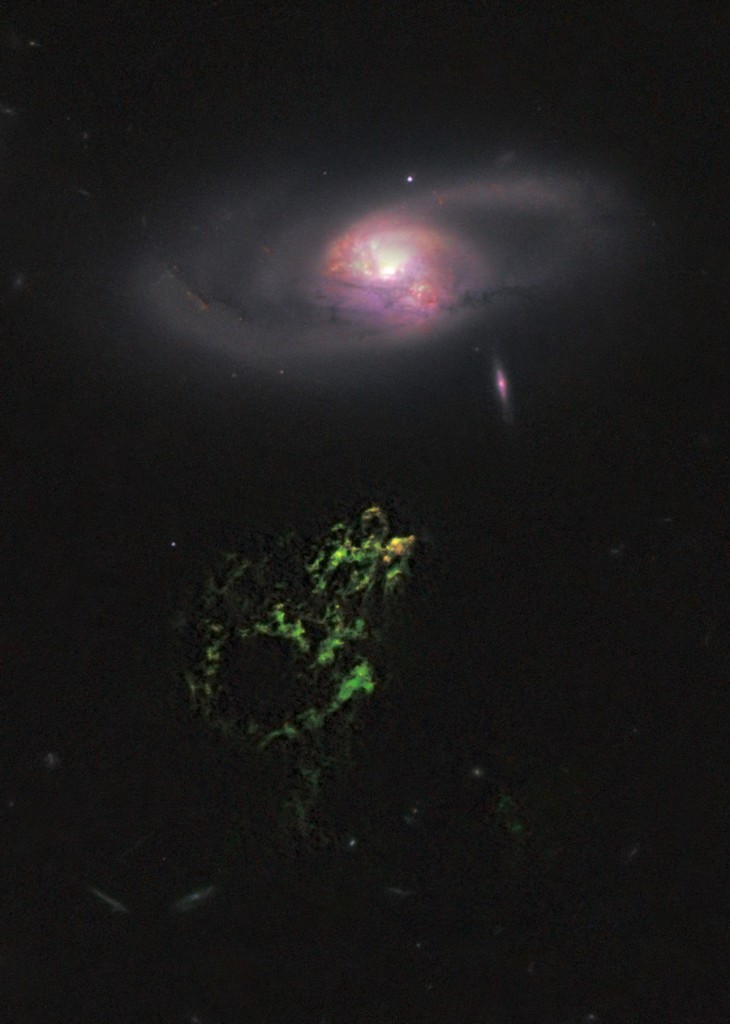
It even looks like a Voorwerp. Don't you think?
When you get bored with Farmville, why not give this a try?
Citizen science is amazing in a thousand ways, but when it becomes highly user friendly and even fun, I think it’s perfect.
UFOs: The moon illusion
Everyone on earth that has seen the moon, knows it looks bigger on the horizon. Most know that it isn’t actually any bigger and many think it’s an illusion created by the comparison to the tops of trees and buildings. What’s really happening though? The answer is fascinating.
I’m definitely not this first person to address this in blog form and I’m not going to be the one that claims to have found the ultimate answer. I am going to be the one to link you to this, which, if you’re willing to read the whole thing, will give you the explanation you’re looking for.

My God, those cacti are HUGE!
Go on, read it! It’s interesting and will increase your overall level of wonder for the world around you.
If you want the quick and dirty version, just watch this video.
How can you be so hot and still be so blue?
I posted a picture of Alberio the other day and it got me thinking about why stars are different colors, that one being a good example of how different individuals can be.
On the surface, it’s not all that hard to understand why these stars vary so drastically in appearance. We’ve all learned by now that stars are just big balls of hydrogen that, under their own gravity, start smashing hydrogen atoms together making helium and booming out massive amounts of energy. My thinking point for today is diversity in the stellar population and the (kinda) simple reason their appearance varies: temperature.

Oh Anteres, you're so cool.
Take a ball bearing, in your mind please (for safety), and start heating it up. At first you don’t see much happening, but eventually you would start to notice a reddish glow. As it continues to get hotter, red turns to orange, then to yellow and eventually white. If you could keep going without melting your mental BB and making a dangerous mess that would light your brain on fire, you can imagine the white eventually glowing brightly with a bluish hue. That’s an analogy for a star’s color, sort of.
Naturally, things are a bit more complicated when you get into the nuts and bolts of it, but fortunately, there’s the venerable Hertzsprung-Russell Diagram to help you see how things compare.

Hmmm, that's very cool, but something seems to be missing.
Notice the lack of green? There are no green stars, even the ones (like our sun) that put out more green-ish light than anything else. The color is directly tied to temperature and it’s easy to understand the lack of green in that context, you never hear about anything being “green-hot”. Additionally, as I said in an earlier post, all colors are our brain’s interpretation of a small slice of light wavelengths, tuned to see the light from our star as “white”. Maybe to some alien that evolved around a hotter or cooler star would see it differently. Maybe to them our sun looks green, and your brain looks delicious.
The thing I find most enjoyable is that both hot and cool stars can be so bright. The processes that make stars shine are INTENSE, and when we talk about “cooler” stars, we’re still talking about seething balls of nuclear fusion. They differ in longevity by huge margins too and many change dramatically as they go through various stages of their lives. It’s all terribly interesting stuff.
For now though, it’s enough to say that now when you look at stars like Betelgeuse and Sirius, you’ll have a better idea of why they look so different.
Science can be funny! Really. I’m Sirius.
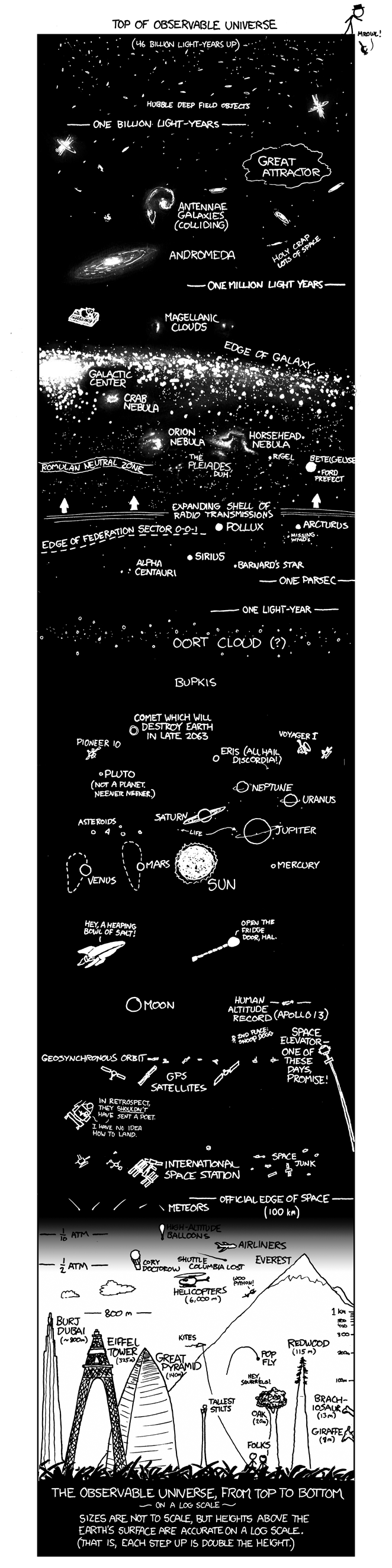
xkcd is some funny stuff!
I spent the day in Wellfleet today, so no time to write. I did see some redtail hawks up close, so that was cool. Anyway, enjoy the comic, I’ll post something real tomorrow.
Attack ships on fire off the shoulder of Orion
It’s easy to forget that when you’re looking up into the night sky, you’re truly looking out into space. The same space we send our probes and image distant galaxies. We forget how close space really is, since it seems like such an inaccessible and inhospitable place. The latter may be true, but astronomy is a way for making the former false. The exact line between our atmosphere and space is a bit fuzzy, but it you only have to travel about 60 miles (straight up) to find it.
Of the things we look out the window of our atmosphere at night and see, the most noticeable (besides the moon) are stars, due to the sheer number of them. The near and biggest planets are pretty easy to see too, since they’re so bright. Beyond these things, there aren’t many sights that really sand out to the naked eye. The (arguably) most famous though, for we northern hemisphere people, is the Great Nebula in Orion. It is great, it is a nebula and it is “in” Orion. We named this one pretty well.
M42, which is one of its many other names and certainly the easiest to type, isn’t far away in astronomical terms, a stones throw at a little under 1400 light years. I suppose that, in space, you could throw a stone at it and it would eventually make it there. It would take a while though, since ONE light year is still about 6 trillion miles. It’s pretty big, which is really why it can be so visible at this distance. The visible portion is about 24 light years across, there are dark portions beyond that though. When you see it at night, you’re actually seeing multiple nebulae. M78 is part of what most people think of as the same object.

You two are dirty, dirty nebulae.
We’re getting into the time of year when the constellation Orion becomes very visible, so take a look. You’re probably already familiar with the three bright stars that make up his belt, and if you can see those, you can probably see this. The nebula would be part of his sword. If you have some binoculars, it’s even more impressive.
So, the next time you look up at Orion on a clear night, take an extra moment and see if you can spot the nebula. As far as seeing attack ships, you may have to wait a few centuries.
Interesting new product Monday: The $1000 eyepiece (part II)
You walk into a store and see a shirt you like, so you check the price tag and it reads $100. “HOLY COW! $100 for this stupid shirt? For that much I can probably get five shirts I like almost as much somewhere else. Forget this”
Let’s try that again, but this time you walk into a “Basement/Outlet/Discount” store and you see a shirt you like. In this scenario though, the shirt has a designer label and the price is $500 $99. “HOLY COW! Only $99 for a genuine DKCKFCBCDG shirt? I’d better buy two!”
Either way, it’s a $100 shirt. Maybe it’s nice, but it had better be for $100.
I don’t know the term for this type of marketing, but it’s so common we almost expect it wherever we go. Like most suggestions or placebos, they still work when we’re aware of them too, which is pretty funny. There are a lot of stores with big floor plans (and wealthy CEOs) that are experts at doing this kind of thing. We LOVE buying things this way.
Telescopes and their accessories are no different. As with everything, there are many ways to market a product, but plenty of astronomical equipment makers enjoy this kind of value-perception catalyzing.
My example of the day is a soon to be released Explore Scientific 9mm 120º 2″ Argon Purged Waterproof Eyepiece.

Wow, I wasn't sure at first, but now all my reservations Argon.
Our Price: $999.95
List Price: $1,499.95
You Save: $500.00 (33%)
If you read the description, this very premium eyepiece certainly seems to have a lot of thought put into it. 120° is quite a FOV and who wants fogging or fungus in their eyepiece? NOT ME! Owning a couple of ES eyepieces, I have no doubt that this will be a very nice thing. They don’t skimp on construction and the people who buy this will love it. They had better, after all.
Gone clubbing
Last night my wife and I went to a meeting of the Aldrich Astronomical Society, out in Paxton. I’m currently a member of the South Shore Astronomical Society, despite being terrible about attending the meetings, but I’m knee deep in a project that is in the Worcester area and Aldrich was the club I wanted to check out.

I was impressed with the meeting and I think my wife enjoyed it too. There was a good presentation on the moon, since it was International Observe The Moon Night, and a few other interesting topics. They pointed a few noteworthy double stars and, being in Paxton, we were able to go right outside and view them, along with the moon, jupiter and a few star clusters.
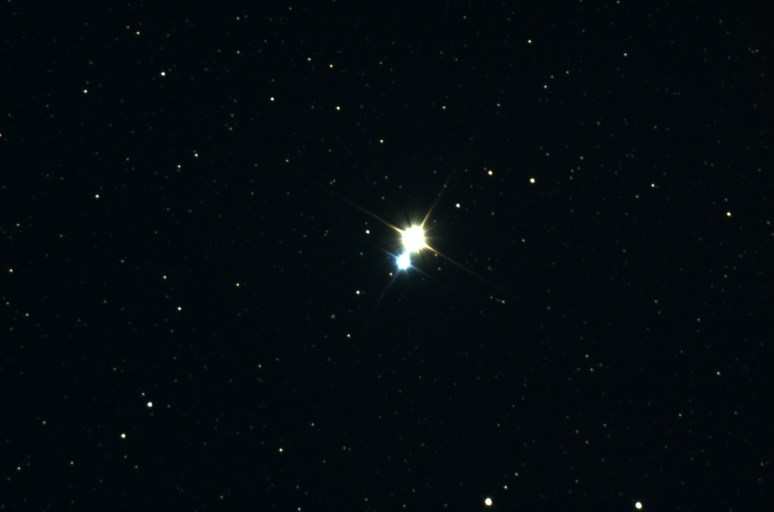
Oh man, the colors! THE COLORS!
I’m definitely going to join and I think I’ll be able to contribute something to this club. They were very welcoming, and an entertainingly motley crew. If you’re interested in astronomy, checking out a club meeting is free, interesting and probably the best place to start. Of course, most people start by buying an expensive telescope, but as I’ve said before, you should start with the free stuff. Aldrich is a good one if you’re in the Worcester area, but no matter where you live, there’s a club near you.
The Canterbury Monks and the Italian pantheist
So, today is the day. Hopefully something happens and I don’t look like a fool for getting you all hyped up about this. In case I was unclear yesterday, there is a very good chance that there will be meteors visible around 4pm today and there is a slight possibility that a lunar impact will occhttps://starhuckster.wordpress.com/wp-admin/post-new.php?post_type=postur. This is one of those times when it’s worth looking, even if not much happens.
I mentioned that seeing lunar impacts are rare. Most are small (difficult to confirm) events reported by amateur astronomers. Since we’re almost at the point where any basic telescope will be capable of astro-photography, I’m sure someone will record something conclusive one day soon.
Up until now, however, the most famous witnessed impact was a long time ago, by human standards. A man named Fratello Gervase (or Gervase of Canterbury) was a noteworthy chronicler of events, but something crazy happened in 1178 that was especially out of the ordinary.

A depiction of daily life in the 12th century.
Gervase was probably thinking about eating some dinner, doing some light evening chronicling and winding down for the evening when five monks ran up to him with a story about something really wild they had just witnessed.
“This year on the 18th of June, when the Moon, a slim crescent, first became visible, a marvelous phenomenon was seen by several men who were watching it. Suddenly, the upper horn of the crescent was split in two. From the mid point of the division, a flaming torch sprang up, spewing out over a considerable distance fire, hot coals and sparks. The body of the Moon which was below, writhed like a wounded snake. This happened a dozen times or more, and when the Moon returned to normal, the whole crescent took on a blackish appearance.”
What we think they saw was an impact that formed the Giordano Bruno crater, though it’s very difficult to confirm. There are alternative theories that they saw a meteor hit our atmosphere and self destruct in just the right place, though as far fetched as the initial conclusion seems, that seems even more so. Perhaps when we can explore the crater first hand, we’ll have a better idea.

This one is fresh, but on the moon, that can still be millions of years old. Still, boom!
Giordano Bruno was a very interesting guy with some progressive (to the point of outrageous, for his time) ideas that eventually got him burned at the stake. I’m going to link to some info on him, but save him for a future post. I’m glad he got the crater named after him, since Gervase didn’t actually see anything and, if i remember correctly, the monks who did didn’t want their names recorded.
I’ll be at work today at 4pm, so hopefully I can find a way to have a look outside. I’m not expecting to see what the monks of Canterbury saw, but I’m willing to take a few minutes and do something that’s free and might yield something amazing. With astronomy, you always get something. I’ve said it before and I’ll say it again: even if all you wind up doing today is looking at the moon for two minutes, you win, you saw the moon. If you read this blog, you probably know more about it than 99% of the world too.
Astronomy = WINNING!
Maybe it’s a lunatic you’re looking for
Tomorrow is gearing up to be a VERY interesting day. First off, it’s International Observe The Moon Night, so you’re encouraged to have a look at the moon. Secondly, tomorrow is the peak of the Draconid meteor shower. Both of these things, on their own, are probably not especially interesting to most people. Together though, they may give you a chance to see a ONCE IN A LIFETIME event!
I’ll give you the quick and dirty version of why the meteor showers happen first. Comets orbit the sun, get heated by it as they come close and the ice and gas start blasting debris into space, forming the tail that is what you’re thinking of when you hear the word “comet”. That tail is also a trail of debris, and sometimes our planet’s orbit takes us right through this stuff, which vaporizes itself whilst hitting our atmosphere, creating a streak of light. This is a meteor and when there are a lot, like when we pass through cometary debris, it becomes a meteor shower.
You may not have heard of the Draconids, but they happen every year. The thing is, you’re usually only getting 10-20 meteors per hour from these, which is great, but even for me this is on the “meh” side of astronomical phenomenon. Tomorrow’s peak is predicted to be as much as 600(!) per hour! This is absurd. This is also ideal if you live in Europe, which I don’t. The peak time here is around 4pm EST.
However, you should still look. There will certainly be a few bright ones that are visible during the day. It’s also possible that one of these big ones will HIT THE MOON! It’s more likely that this will happen before it rises for us here in the Northeast, but let’s look anyway.
This is the “once in a lifetime” part. It’s extremely rare for anyone to see a lunar impact, even less so during the day.
Boom!
Keep your eyes on the northern part of the moon, and it will be visible just over the horizon around 4:30pm. Seriously, if something does happen, you’ll kick yourself if you didn’t even bother to look. Worst case, you see a daytime meteor, which is still pretty rad.
This will also be both the first and last time I ever quote Billy Joel.
Update: This is the first and last time I MIS-quote Billy Joel. Ha!
 History is made at night