History is made at night
Character is what you are in the dark
Asteroid, YU55?
There are a lot of stories floating around today about the asteroid YU55, which you probably know will be passing earth today. A 400 meter wide asteroid is a big chunk of rock, but is in no way a danger to us. When things like this get closer than the moon, people freak. Mostly because hardly anyone realizes how far away the moon actually is.
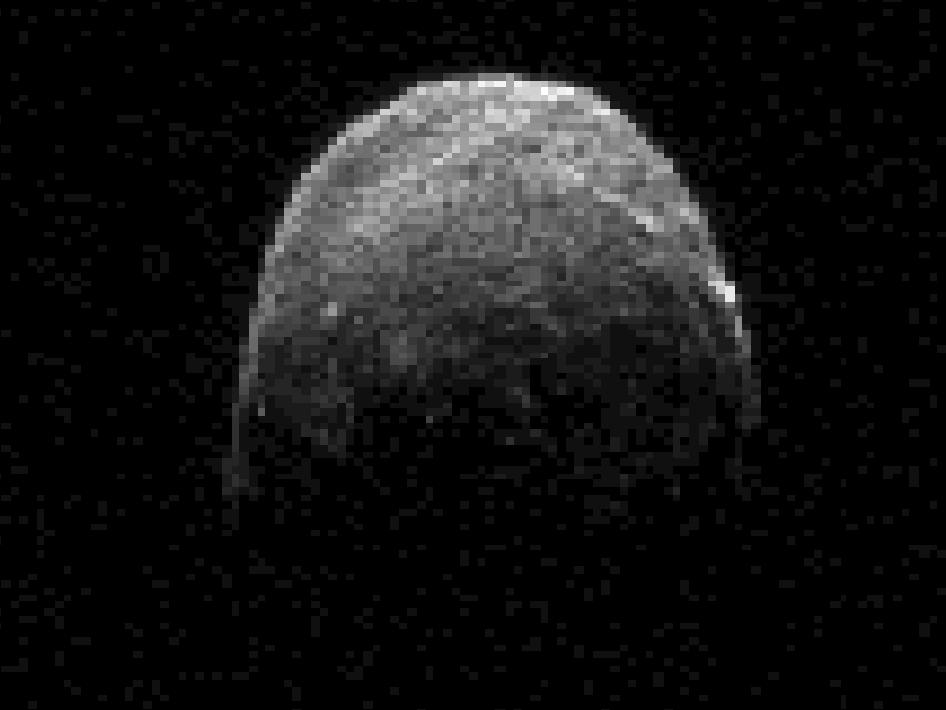
Our encounter with this guy will be quicker than a celebrity wedding and make far less news.
The earth’s diameter is a little less than 8000 miles, the moon is about 240,000 miles away and YU55 will not get closer than about 200,000 miles. That’s close by astronomical standards, but not by any measure than will mess with the day to day happenings on our pale blue dot.
NASA has a pretty good video explaining it all too.
Still it’s pretty cool that we know about it, we saw it coming and we can take decent pics of it. When the day comes that one of these becomes an actual threat, let’s hope we handle it without any fear-mongering and hype. Maybe the odds of that happening are pretty low, but fortunately so is an asteroid impact within our lifetimes.
UFOs: UFOs
For today’s Unqualified Friday Opinion, I thought it would be fun to address my thoughts on Unidentified Flying Objects. Just to get the main points out of the way, I don’t think aliens have ever visited earth (with possible microbial exceptions, but that’s not what we’re talking about today). If you believe that they have, do and maybe helped build the pyramids or bread with neanderthals, then just do us both a favor and read no further. You’re not going to agree with me and I’m not going to change your mind about anything. Beliefs of this nature are not typically subject to reason.

WHOA! Oh yeah, that's definitely an alien spacecraft. I mean, that's the most likely and only plausible explanation.
Don’t get me wrong, I would love nothing more than to know something about alien life and I do think it’s out there. The universe is too gargantuan and life sprung up too quickly and easily on earth for it to be an isolated event. I would guess that life is fairly common, but “intelligent” life is not, and possibly even isolated to earth. Look at it this way: our ability to reason came from millions of years of gradual adaptation and had the conditions been different, might not have happened at all. Of all the things that live (and have ever lived) on this planet, exactly one species can enjoy written language, make plastics and be excited about the new season of The Walking Dead. Dolphins are smart, but it’s a different kind of smart and they’ll probably never have a space program or be worried about whether Kim Kardashian’s wedding was a hoax. You don’t need to be the kind of smart we are to survive, but holy Toledo, does it ever give you an advantage. We’ve enjoyed it, thoroughly, but it’s still a relatively recent development. Our planet had been cranking out life, letting it die off and come back for billions of years before we developed the ability to do this one thing better than anything else. I’d call that quite an exception to the rule. On this point, I truly hope that I’m mistaken and I’m comforted by the fact that the only example we have is our one home planet, so maybe things are different elsewhere.
Maybe you attribute this to something other than a natural process, if so, let’s leave any debate on that topic for another day and get back to the aliens.
So, if my logic is sound, smarty-pants life that can build space ships is super rare. The likelihood of it happening on a planet near enough to us that it’s possible to swing by and do some weekend probing is inconceivably small. There’s another catch too, nothing is really all that close. Within 10 light years of us, there are only 10 stars and half of those are part of multi-star systems. There is nothing to suggest that any planet within this distance has any chance of supporting life, aside from a few possible spots within our own solar system. Maybe with future detection tools we can find some, but if there are any civilizations on them, they haven’t been using their radios.
Bummer.
This means that for aliens to visit us, let’s just say they’re 20 light years away, which is still very local by galactic standards, they would have to travel at the speed of light for 20 years to reach us. For this to work, they will have to have mastered the manipulation of space, time and energy. Even then, it’s still a terribly impractical journey if all you’re going to do is mutilate cattle and artificially inseminate some lady in a trailer park. Don’t even get me started on the crop circles.

This is Alien for "We have come in peace, but thanks in advance for the wheat".
One point many people have made about the sightings of UFOs, that should make any “believer” stop and think, is that there is one kind of person that is almost always looking at the night sky and never claims to see aliens: astronomers. The primary explanation for this is astronomers usually know what they’re looking at and aren’t going to mistake Venus, Jupiter or the moon for a space ship. Even birds are mistaken for UFOs, often. The other reason is that astronomers have a better sense of things interstellar and don’t jump to conclusions, where as many people are happy to see something that isn’t immediately familiar and instantly conclude “ALIENS!”.

Of course, if you think this happens (and many do), there any number of ways to explain all these issues away. I’ve been to the UFO museum in Roswell, NM and have seen what is supposedly very compelling “evidence” of alien encounters, but every single piece of of it is provably non-extraterrestrial, with the exception of personal testimony. When I was young, I read Communion and was totally freaked out that I had been abducted and didn’t even know it. I wanted more than anything to be like Fox Mulder and see through all the lies and conspiracies find the “truth”, but the more closely I looked, all I found was unsympathetic science politely showing me I was barking up the wrong tree.
The human mind is a powerful tool that excels in making any situation, in any context, make sense, somehow. In essence, the world we experience is nothing but our brain organizing and contextualizing sensory input. Everything we see is generated internally, so it’s no wonder we don’t all see the same things. Objectively considering facts and thinking critically is like #57 on the list of things the human mind does well, measuring probability well might not even be on the list at all.

But I don't.
In the end, the truth IS out there, but what you find has a lot to do with what you expect to be there.
There once was a lady from Venus…
June 5th 2012. Remember that date. Hope against hope that the weather is clear. On this day, Venus will transit the sun and it will be readily visible from the northern hemisphere.

It might not be pretty, but this chart shows who will get to see this.
Why should you care? Well, for starters, if you miss this one, you won’t get another chance to see this particular celestial event until 2117. Even if you’re very optimistic about your potential longevity, 105 years is a long time.
This event even has its own website: http: www.transitofvenus.org
Of course, some of you might remember that this happened only seven years ago, so it might not seem like a big deal. Maybe you’re still all Venus-transited out from 2004, but for most people, this will be the first and only chance to see one. The website has all the facts and cool stuff right on the main page, so I encourage you to check it out.You can even get involved on Facebook.
I’ll leave you with a cool video from the 2004 transit though, that shows the “black drop” effect.
Taking two minutes out of your day to witness a once in a lifetime event seems like a no-brainer and someday you might be very happy you did.
Unqualified Friday Opinions: Space travel for the rich and famous
On October 17th, Virgin Galactic opened the world’s first commercial spaceport in New Mexico. This is a big deal and a historic event, even if VG goes nowhere. Richard Branson is no dummy, but he’s also aware that not everything he tries pans out. His willingness to take big calculated risks has obviously been working just fine for him, so no matter what the future holds for VG or this first spaceport, he has done something that nobody else has done before and has already succeeded in that way. Of course, the plan is, I’m sure, to make more billions of dollars.To get the ball rolling, they already have a contract with NASA, who has purchased two flights for $4.5 million.

This is not the actual Space Ship 2, but it is the actual Richard Branson. I think. One of them is not to scale anyway.
It might seem odd that NASA is hiring a private company for research missions, but there’s no question it will make their budgeting much easier and may even allow for more missions and more science to happen that might not have otherwise. It’s not like congress is giving them more money for anything and getting a ride from VG is comparatively cheap.
Of course the point of this was to sell private space flights for people who are not astronauts. At $200,000 per seat, 150 trips are sold and there are over 400 reservations already. As soon as some wealthy guy or gal writes an article in The Robb Report about how their space trip was the greatest thing they’ve ever done with $200K, I’m sure the line will be out the door, so to speak.

The only thing left out of this diagram was the Cristal Brut 1990 'Methuselah' served to the passengers via juice box.
This is the first of what will surely be many such spaceports. There was a time when regular aircraft flight was not for the common man and look how that’s changed. In no time at all we’ll be flying half way around the world in a few hours for not much more than we pay for our current airliner fares, relatively speaking. Of course, by then Richard Branson will probably be an immortal cyborg and have a luxury hotel on the moon. You got to walk before you run though.
Everybody loves black holes (part III)
I’m reasonably certain that the thing the majority of people out there find most interesting about black holes is their power to totally annihilate any matter unfortunate enough to get too close. It is pretty cool. Granted, if you were to step onto a neutron star, you’d be flattened into a thin, greasy film immediately, but it’s still not as exotic as what happens as you pass an event horizon. Of course, in that situation, perspective matters.
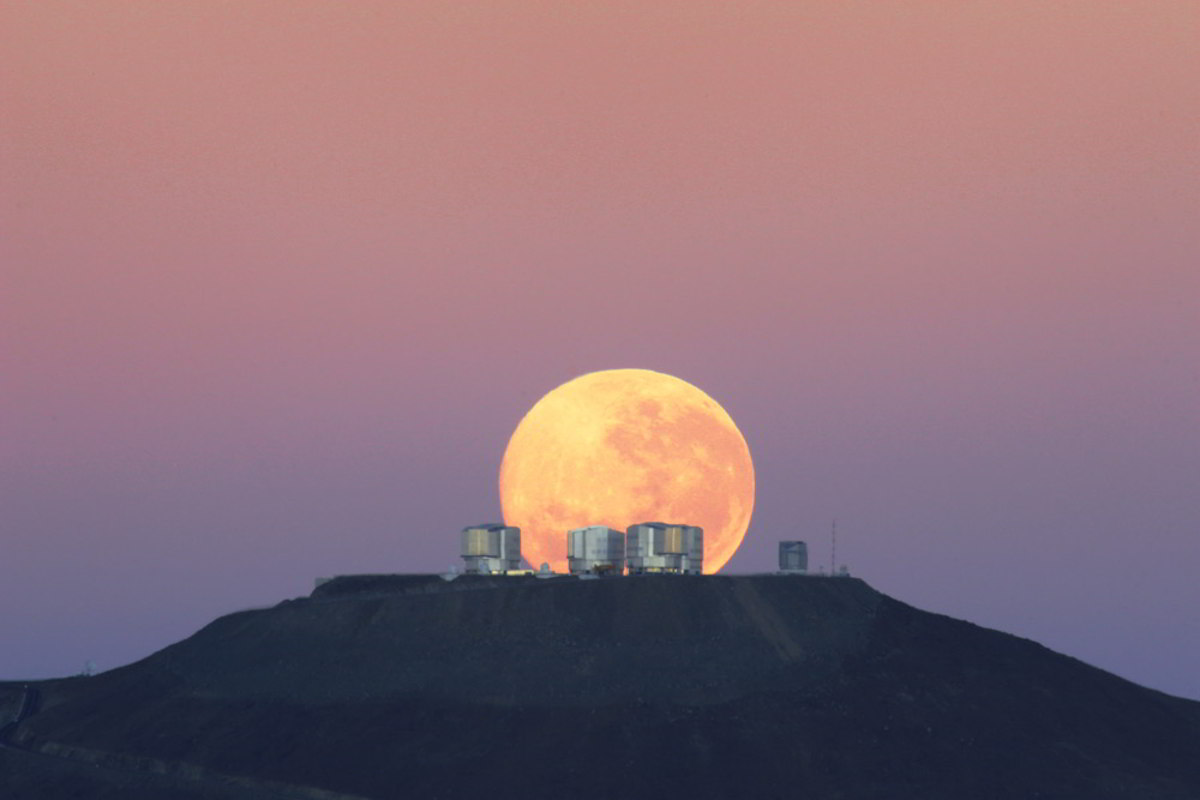
Perspective is important, otherwise you might think the moon is about to smash into these Chilean telescopes.
Let’s get one or two things out of the way though. First, despite what many movies would suggest, you can’t fly into a black hole and come out the “other side”, having traveled back in time to rescue your great-great grandfather from pirates or into an alternate reality where it rains donuts. Remember the neutron star example in the previous paragraph? Those are the things not quite dense enough to become black holes and you’d have about as much luck trying to fly through one of those. Second, to understand what happens “inside” a black hole, you have to open your mind to ideas that don’t play well with common sense experiences. If you’ve ever used a GPS (or even believe that they are real) you have been shown that Einstein’s theory of Relativity is an essentially perfect way to understand the relationship of space-time and gravity. Some of the concepts that allow us to understand this relationship seem counter-intuitive. but after 100 years, even with this recent neutrino fiasco, his theories hold up and are going nowhere. We know it works.
So, let’s get to it. You and your space faring buddies are exploring the old remnant of a supernova and all of a sudden, you realize you’ve flown right into the gravity well of a black hole! Oops. Don’t worry though, it’ll all be over soon.
As you approach the event horizon (also called the Schwarzschild radius), some unexpected things would happen. From your perspective, the event horizon would appear to recede as you approach. Your buddies, observing you from a safe distance, might see you pass through the point of no return, into the blackness, but for you, this is just the beginning of the end. Light is being bent around you and the event horizon you see is now not quite the same thing you were looking at before. How long you have left at this point now has everything to do with how massive the black hole is. Keep in mind, the singularity doesn’t have any size, but the apparent size of the event horizon is dependent on the mass, so the more massive the singularity, the larger the Schwarzschild radius/event horizon. Since this is a “stellar mass” black hole, your trip is a tiny fraction of a second. Blink and you miss your own demise.
Gravity’s pull follows an inverse square law, so if your pals are ten times further away from the singularity, the force on them is 1/100th what it is on you. This only ramps up, fast, as you fall in. Thanks to the way gravity works, when you’re standing up, walking around on earth, the watch on your wrist is actually being pulled towards earth’s center of gravity less (and ticking a bit faster) than the one on your ankle. Everyone wears two watches like that, right? Anyway, for we earthlings, this difference in force is SO small it requires a finely tuned gravimeter to detect it and it takes an atomic clock to measure the time dilation. But for the unlucky you on your way to singularityville, this becomes, um… more “pronounced”.

Black hole chowing down on a companion star. Black holes can be jerks.
By the time this is going on, your watches don’t work anyway. You’ve been instantly pulled apart, starting from whatever unlucky part of you was closest to the singularity, let’s say your feet. The light by what’s left of your head has been shifted into the red, your feet into the blue. It’s all over. Your body has been torn to atoms, your atoms have been stretched out into their subatomic components and those have fallen into that infinitely small and dense point that has been your final destination. The black hole has gained a minute bit of mass and absolutely nothing is left of you. When you crossed the event horizon, you had become separated from space and time and all the information that was you, was gone at that moment.
Here’s a video associated with this article that illustrates this journey.
As an aside… (exciting new product Monday post: stars and motorcycles))
Idiomatic phrases in English rock my world, though possibly not as much as puns, which are the bee’s knees. They can be corny, even so much so as to be nonsensical, but who can’t get into them to some degree?
I’ve mentioned a few times on this blog that I see the benefit of going out and observing beyond simply seeing things in space. For me, it’s also mental-floss, as I think it is for most amateurs. When I’m out there, I make sure that I take some time to stop fussing with my gear and relax, so when my eye is a few millimeters from the eyepiece, I’m calmer, I stay more still and I breathe easier. As it gets colder, this seems to make a bigger difference, for me at least. When I take those few extra minutes to get my head in the right place, I come away from the experience feeling recharged and happy. Even if I’m soaked with dew.
One other activity that yields similar results, that I’m also very enthusiastic about, is motorcycling. The parallels are many. If your head isn’t in the right space, you won’t enjoy the ride, but if you take even a few seconds to let go of whatever ultimately trivial baloney is wasting your mental energy, a good ride will make it all better.
I’ve been thinking a lot about how to combine the two and today I got an email ad (which I won’t call spam since I signed up to get them) from a place I’ve purchased some riding gear, Revzilla. They’re definitely my favorite online shop for this kind of thing and the ad was for a contest they’re having, where you leave a comment on their blog about what riding means to you. So, I thought about it and realized how much I would like to make motorcycling and astronomy happen at the same time. I think I found a product that can help make this happen.
Behold! The William Optics GT:
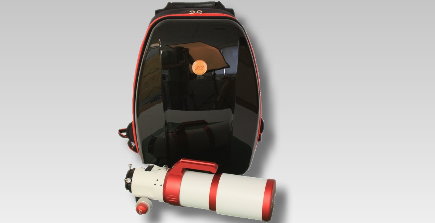
A hard shell backpack style case? Are you kidding me?
This is no cheapo “travel-scope” either, this is a high quality instrument that is suited for astrophotography.That doesn’t mean you can’t use it for observing too though, in fact, I have zero doubt that it would excel in this department. See that red handle on the top? It has a notch in it like a gun sight, so it doubles as a finder. How awesome is that? That means one less thing to bring with you. I see this as a dual-purpose scope; you use it for visual observing as a “grab and go” scope, and you use it for astrophotography when you have the gumption to set it up on a proper tracking mount.
I’m not about to even consider taking my huge equatorial mount and tripod (with 2″ diameter legs) for a ride on two wheels, so there would need to be a portable mount and tripod as well. Fortunately, I think the Astro-Tec Voyager II will fit that bill nicely.

Alt-Az mounts keep it simple. I like simple.
It’s under 15lbs, can support a 20lb instrument, collapses down to a manageable size and requires no electricity. It’s also half the price of some of the other non-cheapo mounts like this, but is still a solid piece of gear. This certainly won’t fit in your pocket, but the size and weight are absolutely manageable for a bike. Depending on the model, it might require some creativity to get it properly secured or stowed, but that’s half the fun.
With these two things, a diagonal and a couple of eyepieces should be about all you need. That’s it, you’re ready to go. I love that idea.
While I’m on this topic, I’m going to also point out a couple of bikes that I think are ideal for observing trips. Certainly there are more motorcycles than I could possibly (practically anyway) mention that would be suitable, almost ANY bike would do for the most part, from the most exotic Italian sport bike to the clunkiest American hog. The current trend in the motorcycle industry for dual-purpose adventure/touring bikes is PERFECT for people who want to ride out into the sticks at night though. They can handle crap roads, they often have long ranges (between fuelings) and offer comfort when you’re heading out for long periods. Also, most are pretty quiet, which I see as a big plus. I don’t really think it’s cool to be screaming or booming through quiet neighborhoods or back roads late at night. Loud pipes DO NOT save lives.
ABS and enhancing your visibility on the road saves lives. There has been a lot of research on this subject, so don’t take my word for it. Look into it yourself if you don’t agree. Also, deer don’t care how much noise you’re making, when they run zig-zag in front of you it’s a predator evasion tactic and it’s totally random.
My top bike picks, because why not, this is a new product post, for 2012 would be the just-redesigned Suzuki 650 V-Strom, BMW G650GS, Kawasaki KLR650 and Triumph 800 Tiger. The KLR is the cheapest, the Triumph is the sportiest, the BMW has the best fuel economy and the Suzuki is the newest and (reportedly) most comfy. There are PLENTY of other bikes that are every bit as good (and maybe better) for this stuff, but these are the ones I like.

I'm willing to bet the skies are pretty dark where they are.
The point of all of this stuff, is do do things you enjoy and that enrich your life. We (meaning me, my family and anyone reading this) are lucky to live in a time and in a country were we can have activities like these as options. These are things that I like, these are things that I enjoy and these are the things I think about. If what you want is to combine your love of dressing chickens up like Victorian aristocrats with extreme hang-gliding, go for it, as long as the chickens don’t get hurt. The only thing you can do that’s wrong (besides hurting chickens dressed up like the Duke of Devonshire when you crash into a mountain) is be too lazy to do what the things that matter to YOU. It’s not always easy, but as Confucius said: “Those who want to do something, find a way. Those that do not, find an excuse.”
That’s what it said on the bumper sticker anyway.
Post delays
Sorry for the less active posting, it’s been a busy week. I’ll be posting the black hole part III thing soon, just have to check all the facts and make sure I’m not spreading any bad information around. Bad information is bad.

The difficulty isn't technical, but technically there are difficulties.
Everybody loves black holes (part II)
In a way, black holes are pretty simple. They have only three properties: mass, charge and spin. If two black holes have equal values of only these three things, they are indistinguishable.
You might already know that when certain stars die, the result is an object that is dense beyond imagination, so that it collapses under its own gravity into an infinitely small point, which we call a singularity. Gravity around the singularity is strong enough to prevent light from escaping, the boundary of where the gravity is this strong is referred to as the “event horizon”, which is a very catchy name, but does what is says it does. There is no information of any kind that survives crossing this line.
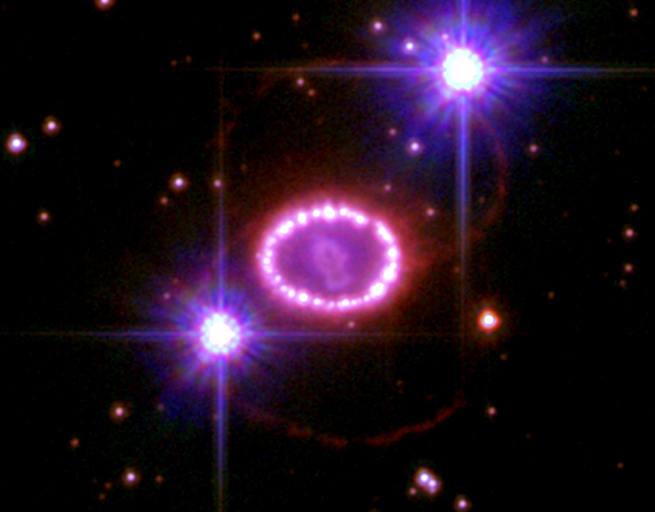
Black hole in 3...2... (well, it actually takes a while, but you get the idea)
They don’t have to be any particular mass, theoretically that can be as small as you can imagine (or smaller), but they do have to be VERY dense. The only natural processes we know of that make them, make them pretty massive. Some are a few solar masses (our sun = 1 solar mass), some are millions or even billions of solar masses. The big ones you’ll find at the center of galaxies, some spewing out GARGANTUAN jets. Note that these jets don’t come out of the black hole itself, nothing does, but are a side effect of matter being drawn into oblivion.

That bright point is M87, a galaxy more than twice the size of the Milky Way, so those jets are BIG.
From there things can quickly get more complicated. The way black holes mess with space-time is pretty wild. Gravity can be represented as a distortion of space-time, often visualized in analogies involving bowling balls sitting on trampolines. The heavier (or denser) the object on the trampoline, the deeper the indentation. Think of a black hole as an infinitely deep indentation, which would incidentally always look black if you peered down into it, even if you shined a light into its depths. It’s a pretty good analogy!

This example puts things in a two dimensional format though, since we can’t imagine what an indentation in three dimensional space would look like. If you add light to your trampoline analogy though, it would be traveling across the surface of it, so when you distort its path, it’s observable. You don’t need a black hole to do this, we now observe this around massive things like galaxy clusters, but a black hole out in the open would do this intensely.
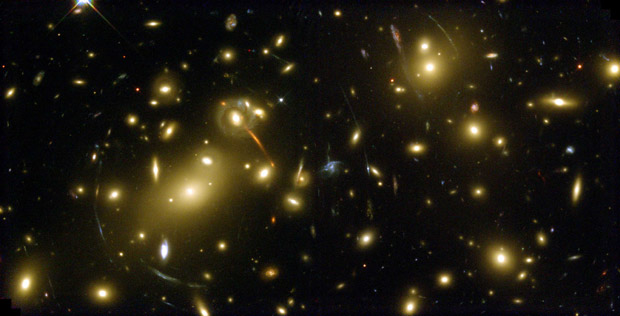
Gravitational lensing in action.
In the next 30-50 years, we may finally be able to directly observe a black hole. I have a feeling doing this will deliver both expected results and a ton of new questions. If you go here, you’ll get a fancier and more interactive introduction to black holes.
I’m going to save the explanation of what you might experience if you were to get sucked into a black hole for part III.
Everybody loves Black Holes (part I)
This past Saturday I attended one of the most unusual events I’d ever been invited to. Don’t get me wrong, it was very enjoyable. In fact, I think I may have enjoyed it more than many of the other people in attendance. This was the annual pot-luck dinner for the astronomy club I recently joined, which featured free food and a lecture on black holes. The free food was expected by everyone, the lecture was probably not what many had in mind.
Dr. Laura Brenneman studies black holes as a postdoc fellow at the Harvard-Smithsonian Center for Astrophysics, so she knows a thing or two about them. From what I gathered, her expertise is in measuring them and analyzing their properties via their effects on whatever happens to surround them. She wrote an article for Sky and Telescope recently, which I think may have been part of the reason she was asked to speak at the aforementioned event.
The talk she gave was clearly dumbed-down for laypeople, but still more technical and more concerned with understanding of measured data than the conceptual stuff people usually look for in black hole related things. It’s my opinion that many, if not most, of the people there would have been more enthusiastic hearing hypothetical stories about extreme tidal forces ripping your friend’s spacecraft to bits when they flew to close to one. Neil DeGrasse Tyson wrote a book that touched on things like this: Death By Black Hole. Titles like that grab the attention a bit more than graphs of shifted iron emission lines, but I can’t say too many times that I really, truly and enthusiastically prefer Dr. Brenneman’s style. Getting a glimpse into the real work of a professional astronomer/physicist/cosmologist is amazing and rare.
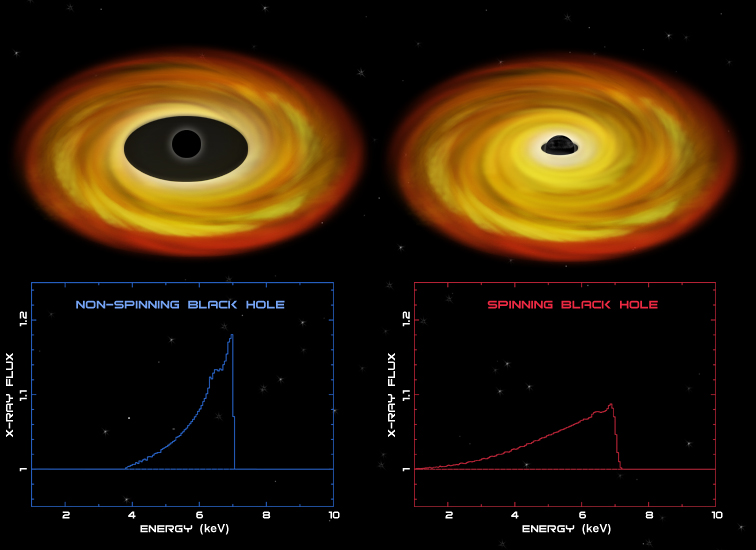
This is how you see something that can't really be seen.
I learned quite a bit about the way black holes spin, emit radiation and behave within galaxies. More interesting still is the way galaxies behave around supermassive black holes at their center. I encourage you to look into it further, if you’re interested.
For the sake of brevity, I’m going to make this part one of two. Tomorrow I’ll post about black holes again.
Interesting new product Monday: Baader Skysurfer V
This week I’m doing more of a product review than writing speculatively about upcoming new products (or bitching about how much some things cost), so I’m hopeful that the usefulness of today’s post will be enhanced by this approach.
I purchased a Skysurfer V a few months ago, but I’d been thinking about getting one for a while. When I first purchased my 8″ Celestron SCT, the finder that came with it was a very cheap and basic “red dot” style finder (this is the thing that lets you know what you’re pointing the scope toward, like the scope on a gun). Replacing it was the first thing I did to that scope and it made it much nicer to use. After I started using my scope more frequently though, I found some things about it bothered me, though I’ll note these things didn’t make it less functional.
So, after some financially induced procrastination, I pulled the trigger on the Skysurfer. It’s non-magnified, all metal and pretty big. In fact, it’s bigger than I thought it would be, but that makes it very nice to use. The style of the thing really brings the gun analogies home as well, it reminds me of the crazy looking scopes you see on sniper rifles in the movies. In reality, it’s more like a black metal paper towel tube, but has an adjustable red dot (once you figure out how to adjust it) and two clear dew shields, which are held on with black elastic cords.
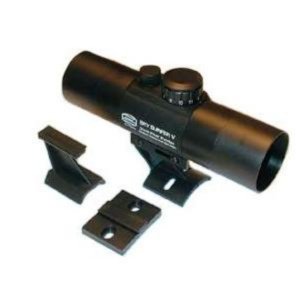
All black metal, all the time! Makes you want to bang your head just looking at it.
The pic links to a product site with more details.
This is a nice, but not necessary item. I suppose you could argue that telescopes aren’t necessary either though. If you have a telescope, the whole point is to use it. Equipping it in a way that makes it more useful is absolutely worth it, I think. If you have a medium sized scope and want a non-magnified finder, I don’t think you’ll find one nicer than this.
 History is made at night