History is made at night
Character is what you are in the dark
Unqualified opinion Friday
Inspired by my wife, who also blogs on here about very different stuff, I thought it would be fun to try different types of posts on different days. Since I’m interested in astronomy and I’m not any kind of expert, I thought it would be fun to share my opinions on certain things that are happening out there in this corner of the world of science.
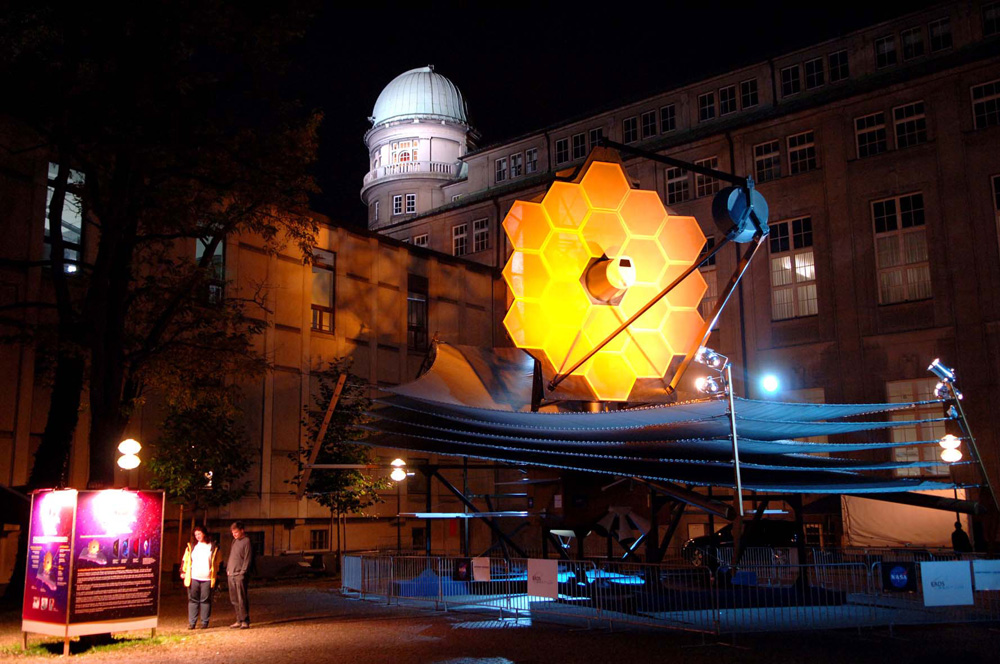
The James Webb Space Telescope has been a source of a LOT of heated debate in the past couple years, but not simply over its value (well, kinda) as our next-generation eye into space. Instead, it’s all about the Benjamins. I attended a lecture at NEAF this past April on the JWST with Heidi Hammel, so I’ve heard a thing or two on this subject from the proverbial horses mouth. She’s on the team and even she had some conflicts about the monetary scale of this project.
What it comes down to is this: the JWST was originally predicted to cost something like five billion dollars, and a few years in, it became very clear that that estimation was WAY off. From everything I’ve heard and read, the common explanation for how the numbers got fudgier than a seaside candy shop is that the usual fudgery that gets fudged wasn’t enough to cover the expected cost excesses. So, they usually build a budget to include a certain amount of overruns on any project, but somehow screwed that part up when planning one of the most expensive single science missions ever. In the end, even if they had done it right, it would have still blown the over-estimate out of the hangar by the time things got really dicey. Add in our current political circus, which is being played out by cutting funding to everything that seems to matter to anyone that has a net worth below $10M, and you have a very large target within an agency that is already under more scrutiny than seems reasonable.
Just this week, to my sincere surprise, congress approved JWST funding with a 2018 launch date. They did not, however, say where it’s coming from. This is where the opinions come in. Since it seems like a disheartening certainty that any funding will come from outside of NASA’s existing budget, some things are going to suffer if JWST is ever going to launch.
I want a base on the moon. I want men and women on Mars. I want detailed exploration of Europa and Titan. Heck, I want more ground based particle accelerator science. But more than these things, for this coming decade, I want JWST to fly.
Hubble has done wonders for public interest in not just astronomy, but science in general. We now have a vision of our corner of space we couldn’t have had otherwise, and let’s face it, we’re visual creatures. We see things and they become real to us, it’s how we’re wired. JWST will show us things at a level nobody has seen yet and can barely even imagine, which in 2011, is a lot to say. Plus, we don’t have to wait years for it to reach its target, which is an unfortunate reality for most planetary science missions. Those missions will still happen too, but with JWST in the sky, we get not only a lot of other science done while those are developed, but we open the world’s eyes to the beauty and majesty of space and all those crazy things floating around in it.
Science needs all the good PR it can get right now and I think this is the best way to get it. In the end, I see this as an investment that pays off HUGELY in the long run. In a more ideal world, no NASA project would have to get cut, but we’d also put a few bucks toward our nation’s education and everyone would accept evolution, so it’s pretty obvious we’re not living there just yet. JWST is big, bold, risky and exactly what I think we need.
This summs up my feeling well:
Reading of the stars

There are quite a few things to do, I’ve found, that keep my interest in astronomy satiated when I can’t get out any actually look at anything. This is a good thing, since getting out there can be such a challenge. Even as I write this, it’s currently something like the 10th cloudy day in a row of cloudy days.
Reading and the internet are my friends in this arena, my cloudy sky BFFs. As far as the internet goes, there is an epic amount of both inspiringly good and laughably bad information to be had, so one of my favorite ways to filter through it all is via blogs. My #1 pal in this department is Phil Plait’s Bad Astronomy. He writes well, he’s an actual professional astronomer, sometimes gets political (though fortunately our politics are aligned) and always sites the source. Also, the blog Universe Today, which is focused on the science stories, but still well written and entertaining. Then there’s the Science Daily‘s astronomy page. This is a good place to see the stories of the day, but often they’re written by journalists, not scientists, which can be a bit hit or miss. Overall though it’s pretty good and if you get the Astronomy Magazine eNewsletter, it’s 90% the same content that shows up on this site. Then there’s the amateur astronomy forum megalopolis Cloudy Nights. Everything from equipment reviews in EXTREME detail (like guys taking their new eyepiece to a full-fledged optics lab for bench tests) to forum discussions on every imaginable topic.
The books I read keep me going as well. The few I’ve read on the subject lately that stand out are Titan Unveiled, which is a detailed look at Saturn’s smoggiest moon and the way the science was performed via the Cassini spacecraft. If you’re curious about Titan, it’s a totally bitchin’ read. If you don’t care about lakes of hydrocarbons or cryo-volcanism, reading this one would be about as much fun as lighting your face on fire. How I Killed Pluto, on the other hand, is probably enjoyable by anyone with even a passing interest in anything more intellectually stimulating than Jersey Shore. It’s a quick, fun, read and shows the human side of the scientist and author, Mike Brown. Right now I’m reading The Sun’s Heartbeat by Bob Berman, my favorite columnist for Astronomy Magazine. It’s an amusing look at the science of the sun and the sordid history of it all. I’m digging it so far anyway.
Of course, the magazines are great too. I’ve mentioned Astronomy Magazine twice now, as if they were paying me, but Sky&Telescope is also one to which I subscribe. They’re both great and when they finally get their digital subscriptions going a little more smoothly, I’ll be excited to switch to those and to ditch the tree-killing hard copy. I’m a member of organizations like The International Dark-Sky Association as well, so I get their publications, if only occasionally. I love those guys, they have a very pragmatic approach to conservancy.
So, there you go. This is what I do with my amateur astronomy when I can’t use a telescope. I’m lucky to live in a time when so much is available to me. Still, I’m always looking for more and if I find something cool, you can be sure I’ll post it up here.
Oh my gear!

Pretty much every amateur astronomer has one thing in common, besides an interest in astronomy. GEAR! Man, do we love our equipment. Some get obsessed with the biggest scope (there’s even a brand of HUGE scopes that embrace this), some get intensely focused (did I mention I love puns?) on the quality and precision of the instruments resolving power. Then there’s the astro-photographers, the DSO (deep sky object) aficionados, the star splitters, technophiles (who would ideally have thought controlled computerized tracking systems), Luddites (who only want to do everything as it was done 50 years ago), planetary enthusiasts (like me), comet hunters and a few oddballs that get into stuff like amateur spectroscopy, which I happen to find very interesting. Most amateurs are a collage of these types, which make most of them fairly interesting and unique. Every single one of them gets revved up over whatever kind of stuff thy happen to have and I’m no exception.
My main scope is currently an 8″ Celestron SCT (purchased as an 8SE) with a Moonlite focuser and sitting on an iOptron PR-GEM mount. It’s on the big side of portable , but I can still lift the entire thing (mounted and assembled) and move it around, which is my definition of “portable”. I also have a bunch of little mods to make it slightly more useful, like a Baader finderscope and Televue diagonal. Plus a bunch of good quality eyepieces, which I’ll probably go into detailing at some point in the future.
 History is made at night